 Smart Printer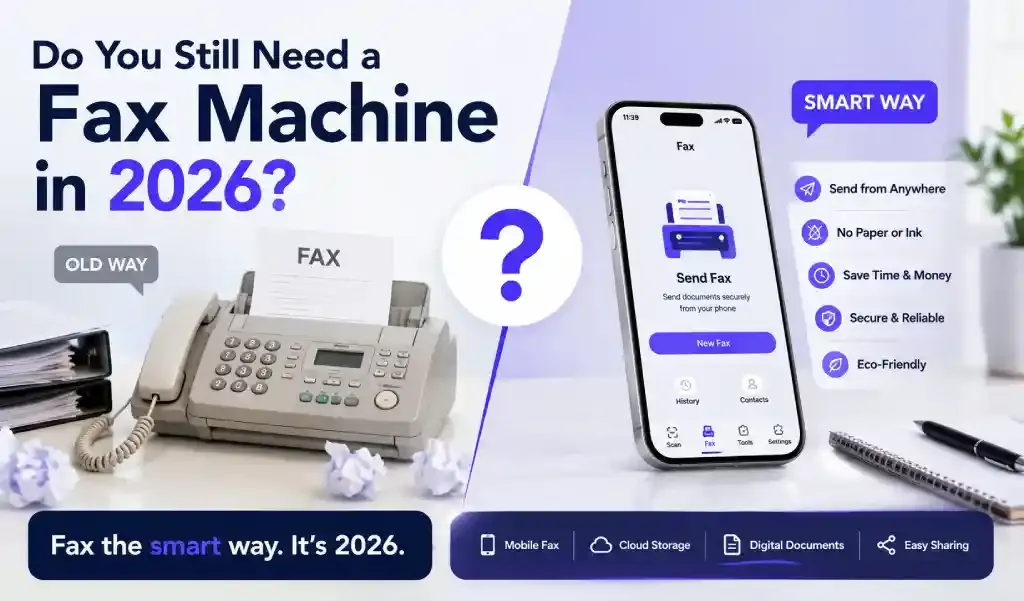
No, you don't need the machine sitting on a desk. But the fax itself hasn't gone anywhere, and depending on who you do business with, you might need to send one this week.
That's the confusing part. Fax got written off as obsolete years ago, right around the time email and cloud storage took over the office. And yet doctor's offices still ask for a faxed referral. Law firms still fax signed contracts. Government agencies still process paperwork that arrives by fax and nothing else. If you've ever heard "we don't accept email, but you can fax it," you already know the technology never actually left. It just moved.
Who's Still Faxing in 2026
More people than you'd think. Industry estimates put the number at roughly 17 billion faxes sent worldwide every year, and healthcare accounts for a huge share of that. Surveys of medical practices put fax's role in day-to-day clinical communication somewhere between 70% and 90%, depending on whether you count fax traffic that flows automatically through electronic health record systems. In the U.S. alone, healthcare providers exchange billions of fax pages a year.
It's not just American hospitals holding on. A 2024 survey of German companies with 20 or more employees found that more than three-quarters still use fax regularly. In Japan, a government survey found over 70% of public schools still fax documents as a matter of daily routine, a habit tied partly to a legal culture that still leans on physical stamps and paper trails.
Government agencies are their own category. Plenty still require fax for certain filings, simply because their intake systems were built around it decades ago and never got replaced.
Why Fax Won't Die
None of this is nostalgia. Fax survives because it solves problems that email, texting, and file-sharing links genuinely don't.
It doesn't require both sides to use the same software. A fax number is a fax number. It doesn't matter if the sender is on an iPhone and the receiver has a forty-year-old machine bolted to a wall in a records office — the transmission still works.
It leaves a timestamped paper trail. A fax confirmation page shows exactly when a document was sent and received. Courts, insurers, and compliance teams treat that as meaningful proof in a way that "I emailed it, check your spam folder" never quite matches.
It's built into regulated workflows that are expensive to rip out. Healthcare IT systems in particular were designed around fax as a delivery method. Replacing that across an entire hospital network, or an entire country's healthcare system, isn't a weekend project. It's a multi-year undertaking, which is exactly why so many providers haven't done it yet.
The Machine Is Dying. The Fax Isn't.
Here's the actual shift happening in 2026: physical fax machines and the analog phone lines they depend on are being phased out. Telecom carriers have spent years retiring old copper landline infrastructure, and that's slowly making traditional fax hardware harder to keep running.
But fax as a way of sending a document hasn't declined at all. It's moved to the cloud. Online and cloud-based fax services have grown steadily, with the market valued in the billions of dollars and projected to keep expanding through the early 2030s. Businesses aren't giving up fax. They're giving up the machine.
That distinction matters, because "do I need a fax machine" and "do I need to be able to fax" turn out to be two completely different questions.
Do You Actually Need a Physical Machine?
For almost everyone, no.
Unless you work somewhere with a hard requirement for an on-premises analog machine, which is rare and getting rarer, there's no real reason to own one anymore. A physical fax machine costs money, needs a dedicated phone line, jams, runs out of toner, and does exactly one thing. An online fax service, or a fax feature built into an app already on your phone, does the same job without any of that.
How to Send and Receive a Fax Without One
It's simpler than people expect:
- Attach the document — a PDF, a scanned page, or a photo of a signed form.
- Enter the recipient's fax number, the same way you'd enter a phone number.
- Send it. The app converts and transmits it exactly like a traditional fax machine would.
- Get a personal fax number if you also need to receive faxes, so replies land in an inbox instead of requiring a machine sitting somewhere waiting for a call.
Apps like Smart Printer: Print Scan Fax handle this from a phone — attach, address, send — with delivery confirmation and no landline required.
Quick Answers
Is fax actually still used in 2026? Yes. It's most common in healthcare, legal services, government, insurance, and finance, where compliance requirements and legacy systems keep it in daily use.
Why hasn't email replaced fax completely? Some organizations are effectively required to accept fax as proof of a signed or submitted document, and a fax transmission leaves a timestamped delivery record that email doesn't reliably provide.
Do I need to buy a fax machine in 2026? No. Online fax services and fax-enabled apps send and receive faxes from a phone or computer, with no machine or dedicated phone line required.
Is online faxing secure enough for medical or legal documents? Reputable online fax services encrypt transmissions and provide delivery confirmation, which is why regulated industries have shifted to them rather than abandoning fax altogether.
Send a fax from your phone in seconds with Smart Printer: Print Scan Fax — free on Google Play and the App Store.